

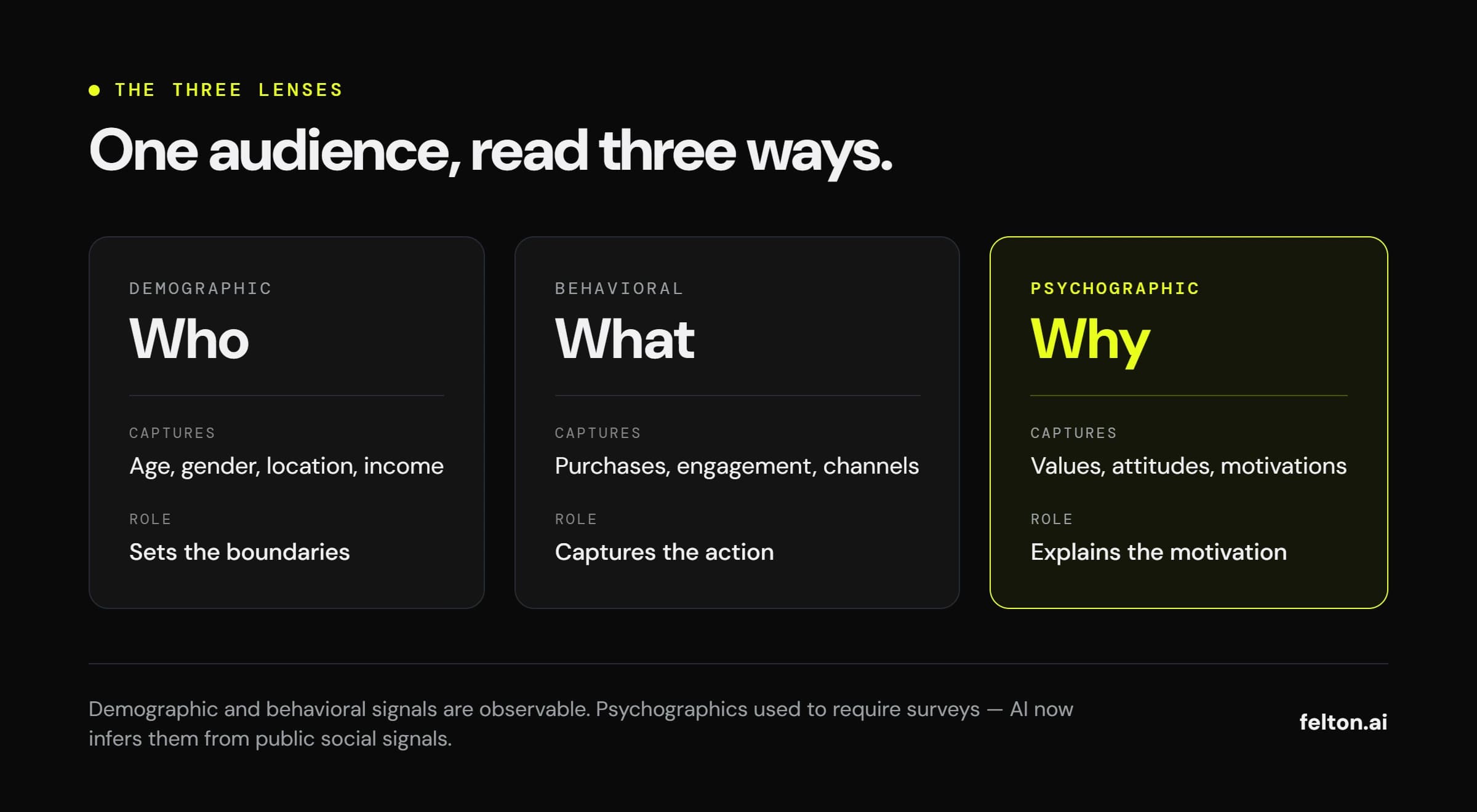
Demographic, psychographic and behavioral segmentation are three lenses for dividing an audience into meaningful groups. Demographic segmentation answers who your audience is. Behavioral segmentation answers what they do. Psychographic segmentation answers why they do it. Used together, the three lenses build a complete picture of any audience; used in isolation, each one misses what the others reveal.
The frameworks themselves are decades old. What has changed is how the data behind them is collected. Demographic and behavioral signals were always observable. Psychographic data, traditionally gathered through surveys, focus groups and frameworks like VALS, was the slowest, most expensive and least current of the three. In 2026, that bottleneck no longer holds. Public social interactions across social media generate continuous signals about values, attitudes, motivations and lifestyle at a scale traditional research methods were never built for: more than 5.7 billion social media user identities worldwide as of early 2026.
This guide explains how each of the three segmentation types works, where each one has limits and how modern audience intelligence platforms bring all three together.
What is audience segmentation?
Audience segmentation is the practice of dividing a broader audience into smaller groups that share specific characteristics, so each group can be understood, targeted and communicated with on its own terms. The opposite of segmentation is treating every audience member as identical, which produces generic messaging, mispriced sponsorships and campaigns that resonate with no one in particular. The payoff for getting it right is measurable: McKinsey finds the fastest-growing companies derive 40% more of their revenue from personalization than their slower-growing peers — and that kind of personalization is impossible without segmentation.
Segmentation matters more in 2026 than it did a decade ago for one structural reason: audiences have fragmented. The single mass audience that defined broadcast media has been replaced by dozens of overlapping micro-audiences, each with its own platform habits, cultural references and emotional triggers. Reaching them requires understanding them at a finer grain than demographic averages allow.
The three foundational segmentation types are demographic, behavioral and psychographic. Each captures a different dimension of who an audience is. The rest of this guide walks through each one, where each excels and what each misses on its own.
Demographic segmentation
Demographic segmentation divides an audience by observable, factual attributes: age, gender, location, income, education, occupation, household composition and similar variables. It is the oldest and most widely used form of segmentation because the data is structured, comparable and available in almost every analytics tool.
Demographic data is useful because it sets boundaries. It tells you that an audience skews 60% female, concentrates between 25 and 34, lives in three urban regions and trends middle-income. That picture is genuinely informative for sponsorship valuation, media planning and basic targeting on advertising platforms.
But demographics describe categories of people, not the people themselves. Two thirty-year-old women in São Paulo with the same income can have completely different values, motivations, media habits and brand affinities. A demographic segment is a starting point, not a strategy. Marketing teams that stop at demographics end up with personas that look statistically defensible and feel hollow in practice.
The other limit is that demographic averages mask important variation. A campaign optimized for a 25-34 demographic may be ignored by the 25-year-olds and irrelevant to the 34-year-olds. Resolving that requires layering behavioral and psychographic data on top.
| Dimension | Demographic segmentation |
|---|---|
| What it captures | Age, gender, location, income, education, occupation, household composition |
| How it is obtained | Self-reported profile data, platform analytics, third-party data providers (Acxiom and similar), inferred from public signals |
| Example use | Setting sponsorship pricing based on audience age and geographic distribution |
| Limitation | Describes categories of people, not the individuals; two people in the same segment can behave completely differently |
Behavioral segmentation
Behavioral segmentation divides an audience by what they actually do: purchases, content consumption, engagement patterns, frequency of interaction, channel preferences and lifecycle stage. It is rooted in observable action rather than self-description, which makes it the most reliable predictor of future behavior of the three.
Inside a single platform, behavioral signals are straightforward. An e-commerce business can segment customers by recency, frequency and monetary value. A streaming service can segment viewers by watch time, content category and binge versus dip patterns. A social platform can segment by posting frequency, reply behavior and the formats a user engages with most.
The picture changes when behavior is read across platforms. A person who follows a brand on one network, replies to it on another, watches its long-form content on a third and ignores it on a fourth is showing a very different pattern than someone who engages on a single platform. Multi-platform behavioral data captures the texture of how an audience actually consumes a brand, not just how they consume one slice of it. Audience intelligence platforms that profile behavior across social media can identify these patterns at the individual level, which native platform analytics alone cannot.
Behavioral segmentation has two limits. First, it tells you what an audience does without explaining why. A drop in engagement could mean a content fatigue problem, a competitive pull, a price objection, or an emotional disconnect; behavior alone cannot distinguish them. Second, behavioral models are reactive: they describe what has already happened. Predicting what an audience will do next requires layering psychographic context on top.
| Dimension | Behavioral segmentation |
|---|---|
| What it captures | Purchases, engagement frequency, content preferences, channel usage, lifecycle stage |
| How it is obtained | Platform analytics, CRM data, behavior signals across social media, purchase history |
| Example use | Identifying high-value customer cohorts for retention investment, separating heavy users from lapsing ones |
| Limitation | Explains what audiences do, not why; reactive rather than predictive on its own |
Psychographic segmentation
Psychographic segmentation divides an audience by internal characteristics: values, attitudes, motivations, lifestyle, interests, aspirations and worldview. It explains why an audience behaves the way it does. Where demographics describe who a person is on paper and behavior describes what they do, psychographics describe how they see the world and what drives the choices they make.
What psychographic data actually covers
Psychographic profiling typically covers five dimensions: values (what an audience believes is important), attitudes (their stance toward issues, categories and brands), motivations (what they are trying to achieve or avoid), lifestyle (how they spend their time, money and attention) and interests (the topics and activities they actively engage with). Personality traits, cultural identity and emotional disposition sit inside this same family. None of these dimensions is visible in demographic or behavioral data alone.
How psychographic data was traditionally collected
For most of the discipline's history, psychographic data came from surveys, focus groups and panel-based frameworks. The VALS (Values, Attitudes and Lifestyles) framework, launched by SRI International in 1978 and still operated today by Strategic Business Insights, segments consumers into eight psychographic types based on a long survey instrument. Major research firms built panel-based products that ran similar instruments at scale. Data brokers like Acxiom layered psychographic categories onto purchase history and demographic records.
These methods are still valid, but they have known constraints. Surveys depend on what people are willing to say about themselves, not what they actually believe. Fewer people respond at all: Pew Research Center telephone survey response rates fell from 36% in 1997 to 6% by 2018, shrinking the base these methods draw on. Panels lag the present by months. Frameworks built decades ago miss cultural shifts that have changed how identity, lifestyle and brand affinity work. And none of them scale to the size of a modern social audience.
How AI and social signals change psychographic segmentation
Public social interactions reveal psychographic signals continuously. The topics a person posts about, the way they post about them, the brands they associate themselves with, the communities they participate in, the language they use and the emotional register of their reactions all carry psychographic information. AI models trained on these signals can profile values, attitudes, motivations and lifestyle without ever sending a survey.
Felton operates in this space. Its platform builds psychographic profiles from public interactions across social media, layering AI-detected lifestyle, interest and emotional patterns (covering 25+ emotions) alongside brand affinity signals and behavioral context. Established competitors like Brandwatch and Audiense approach the same problem with different methodologies — Brandwatch from a consumer intelligence and social listening foundation, Audiense from social graph and persona-building. What all of them share is the recognition that psychographic data no longer has to come from surveys to be useful.
| Dimension | Psychographic segmentation |
|---|---|
| What it captures | Values, attitudes, motivations, lifestyle, interests, worldview, emotional disposition |
| How it is obtained | Historically surveys, focus groups, VALS-style frameworks; in 2026, increasingly inferred from public social signals at scale |
| Example use | Differentiating segments that look identical on paper but respond to completely different brand messages |
| Limitation | Inference quality depends on signal volume; small or low-activity audiences offer less material to profile against |
Why modern audience intelligence integrates all three
Modern audience intelligence platforms integrate demographic, behavioral and psychographic segmentation because each type answers a question the others cannot. Used in isolation, a segmentation strategy is always a partial answer. Used together, they reveal not just who an audience is and what they do, but why they do it and what they are likely to do next.
The difference is the difference between knowing that 60% of your customers are women aged 25-34 and knowing that within that group there are three distinct segments: one motivated by status and brand affinity, one motivated by community and shared values, one motivated by utility and price. The demographic data alone would treat them as one cohort. The behavioral data alone would tell you what each segment buys but not why. The psychographic data alone would describe their values without anchoring them to a real population. The integration is what makes the picture decision-useful.
An audience intelligence platform operates over all three simultaneously. It profiles each member of an audience demographically, observes their behavior across multiple platforms and infers psychographic signals — values, attitudes, motivations, lifestyle and emotional patterns — from what they post, share and engage with. The result is a layered audience map that supports sponsorship valuation, content strategy, segmentation activation and brand positioning with the same underlying dataset.
This is the gap audience intelligence closes that social listening does not: turning conversation data into person-level understanding across all three segmentation dimensions.